
Russia attacks Kyiv with ballistic missile: Air Force reports launch
An explosion was heard in the capital during an air raid alert, while the Air Force reported a ballistic missile launch towards the city.
An explosion was heard in the capital during an air raid alert, while the Air Force reported a ballistic missile launch towards the city.

Minister Mykola Kalashnyk and Dutch ambassador Ruulof van Eys discussed the continuation of the Ukraine Partnership Facility programme and the involvement of Dutch companies in the construction of temporary bridges.

Law enforcement have completed the investigation into the illegal import of vehicles worth over 1.95 million hryvnias, which were processed as humanitarian aid.

Ukrainian President explained why there was no large-scale grouping of the Armed Forces of Ukraine on the Belarusian axis at the start of the full-scale invasion.

Analysis of Pavlo Horbashenko's declarations shows the dynamics of changes in his assets, which correlate with family circumstances and financial decisions.

Oleh Syniehubov reported on the aftermath of the attack on a market in Kharkiv Oblast. Two people were killed and 11 were injured.

Ukrainian President explains that Washington can easily force the Kremlin into dialogue through sanctions passed by Congress, but does not do so.

The Czech leader believes that the lifting of sanctions on fuel supplies from Russia reduced pressure on Moscow and complicated the peace process.
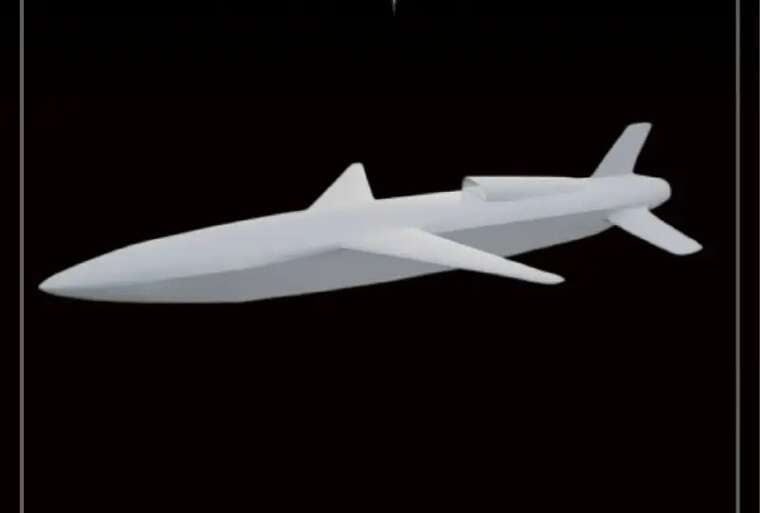
The Main Directorate of Intelligence of the Ministry of Defence of Ukraine (GUR MoD) posted an interactive three-dimensional model of a new Russian cruise missile on the specialised portal War&Sanctions. Along with the visualisation, data on its structural parts and electronic component base were released. The agency noted that the adversary began using this type of armament in late summer 2026.
The developer is NPO Molniya, which is part of the Tactical Missiles Corporation holding. The creation of this missile continues the general trend of the Russian military-industrial complex, aimed at producing cheap air attack means equipped with jet engines and designed for launch from ground platforms.
The missile fuselage is 3.5 metres long, with a wingspan of 3 metres. The structure is made of composite materials, specifically carbon fibre and glass fibre. Some units are produced using additive technologies (3D printing).
According to GUR data, the maximum flight speed claimed by the adversary reaches 800 km/h, and the range of impact is up to 1,200 km. The missile is capable of maintaining a very low altitude or climbing to a level of up to 6 km. There are modifications with warheads weighing 50 and 100 kg. Launch is carried out from a ground installation using a powder accelerator.
The onboard equipment is manufactured by the company PLAZ. This producer is also involved in the creation of the Garpiya drone, which is a modification of the Geran-2 (series K, KB, KC, etc.) produced at the IEMZ Kupol plant. The Filin and Garpiya blocks have a similar layout and marking.
The guidance system is provided by a Chinese inertial navigation system and the 16-channel Kometa system. Although the electronic components are similar to those installed in other Russian missiles and UAVs, the share of Chinese components is increased in this model: 35% are American, and 22% are Chinese. Solutions for various blocks and boards are unified.
The missile's power plant consists of the R500 engine, manufactured by the Russian company Reynolds. A similar unit was previously identified in the S-71K Kover and S-71M Monokhrom air-launched cruise missiles.
The GUR MoD of Ukraine emphasised that it continues to study the adversary's new developments.
Comments
No comments yet. Be the first!