
Journalists uncover hidden assets of MP Vatsak: $3.5m car fleet and state losses
Investigation reveals network of luxury cars in Gennadiy Vatsak's circle and series of violations in his business causing multi-million losses to state budget.
Investigation reveals network of luxury cars in Gennadiy Vatsak's circle and series of violations in his business causing multi-million losses to state budget.

Law enforcement officers discovered a contraband batch of electronics in a minibus crossing the state border via the Krakovets – Korchova checkpoint.

A court in Chernihiv has sentenced the head of a military medical commission to prison for establishing and leading an organised group that issued fictitious medical certificates.

Officers Mykola Savchenko and Ihor Voloshko rescued a woman and her grandson from the rubble after a Russian shelling. During the evacuation, Savchenko lay on top of the child to protect him from a new UAV launch.
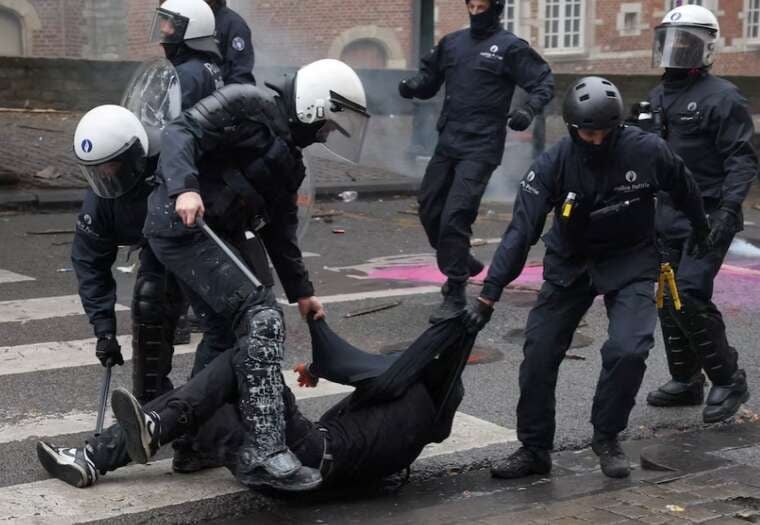
Mass march in Canada for affordable education ended in riots. Police used tear gas, and three demonstrators were detained.

Major tech giants are financing their own clients to purchase their services. The IMF has allocated $1.4 trillion to such cyclical deals.

The Ukrainian tennis player secured a victory in the final round of the group stage with a score of 6:3, 3:6, 6:1 and will continue her campaign at the tournament in Indian Wells.

The Cabinet of Ministers approved a bill on updating the strategy, which provides for the restoration of war-damaged territories and the integration of EU requirements.

We have already reported on how an unnamed intermediary offered the Espresso publication money to remove an article about the procurement of World War II mines for the Armed Forces of Ukraine.
Here is the investigation itself.
Ukraine has signed a contract to purchase anti-tank mines manufactured more than 80 years ago.
The deal has raised numerous questions about the feasibility and safety of such acquisitions. The mines, which cost approximately €600 each, are being supplied through a Bulgarian intermediary company.
The history of the old M6A2 mines
The M6A2 mine charges were developed in the US in the 1940s and used in various wars. These mines are designed to destroy tanks and other armoured vehicles; however, more than eight decades have passed since their production.
Despite this, the documentation states that the seller guarantees their fitness for service. Such a procurement has cast doubt on the actual combat capabilities of these mines.
The Bulgarian intermediary and dubious guarantees
A Bulgarian intermediary company is responsible for supplying these mines, having offered them to Ukraine at a price of €600 per unit. In addition to the age of the weaponry, the model itself raises questions. These mines were removed from US service in the 1960s after it was found that their power was insufficient for effectively destroying tanks.
No such mines remain in US stockpiles, although in other countries, such as Vietnam, they continued to be used until recently.
Technical suitability: how old mines may affect safety
Questions arise as to whether these old mines will even function. Some experts believe that due to prolonged storage in third countries, the mines may have lost their combat qualities. Corrosion of the metal casing may reduce sensitivity, thereby lowering the effectiveness of the mines in combat conditions.
The need for mine procurement in wartime
Anti-tank mines are a vital element of defence, especially during active hostilities. But is this procurement justified? In 2024, Ukraine faced a shortage of TM-62 mines and similar models, necessitating the urgent replenishment of stockpiles.
However, the purchase of old mines, despite the critical need for such munitions, raises questions about the long-term reliability of these combat assets.
Budgetary impact and urgent decisions by the Defence Procurement Agency
It is possible that the signing of the contract with the Bulgarian intermediary was linked to pressure on the Defence Procurement Agency to meet budgetary commitments. At the end of 2024, there was an urgent need to spend allocated funds, and this contract became one way to meet the plan.
Based on materials from the Espresso website
Comments
No comments yet. Be the first!