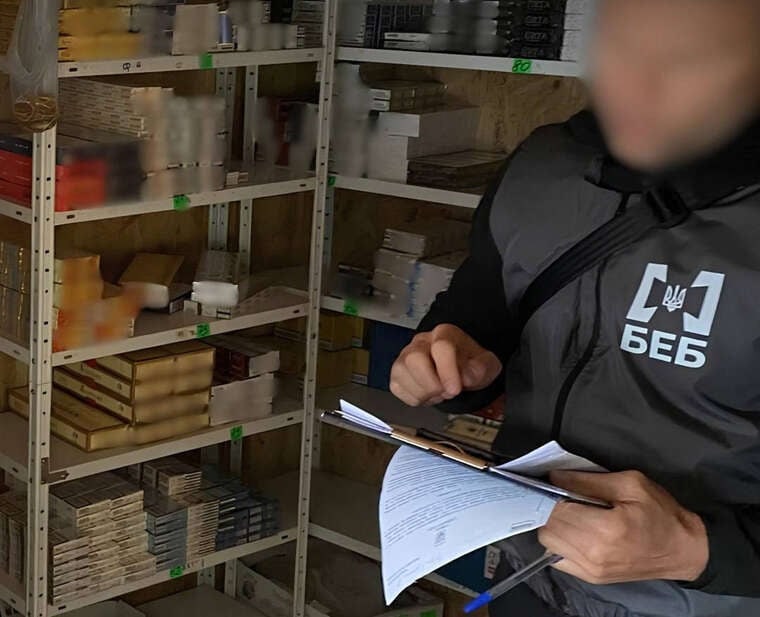
BEB dismantles network of kiosks selling counterfeit tobacco in Kyiv region
Five outlets selling cigarettes without excise stamps were shut down in Brovary and Obukhiv districts.
Five outlets selling cigarettes without excise stamps were shut down in Brovary and Obukhiv districts.

Fire Point co-owner denied reports of a bodyguard's death but did not refute the fact of the attempted murder.

Military journalist Serhiy Auslander reported an assassination attempt on the head of Fire Point. Preliminary data indicates the attackers were killed and the company head sustained minor injuries.

Kremlin spokesman stated that Russia sees no reason to wait for the end of the conflict in Ukraine to resolve joint projects with the US, while Washington maintains a different position.

Investigation revealed that contractor Oleksandr Chervony received nearly 50 million hryvnia for the engineering protection of the facility, but construction ceased after part of the work was completed.

The US administration has launched a large-scale campaign against invasive insects in the capital. By 2028, their numbers are planned to be significantly reduced using biotechnologies and ecological methods.

The regulator found that 95.8% of cash processed through post offices over 19 months was deposited by just six payment operators. The NBU fined the company and deemed its head unfit for the position.

Mayor Vitali Klitschko announces the suspension of metro and surface transport due to damage to the support structure of the South Bridge.
On 29 September, Donald Trump signed an executive order initiating a large-scale programme to combat invasive mosquitoes and ticks in Washington. The main goal of the document is to reduce the population of invasive mosquitoes by 90% and ticks by 50% by 2028.
The primary targets of the measures are the Asian tiger mosquito (Aedes albopictus) and the Egyptian mosquito (Aedes aegyptus). The White House emphasises that these species are actively spreading across the US territory and have already become dominant in the District of Columbia.
The presence of these insects poses serious risks to public health. Mosquitoes can be carriers of the West Nile virus, Zika virus, chikungunya, and dengue fever. Ticks, in turn, are associated with the spread of Lyme disease, babesiosis, Rocky Mountain spotted fever, and other infections.
To implement the plan, the Department of the Interior, the Department of Agriculture, the Environmental Protection Agency (EPA), and the General Services Administration have been given 60 days. Within this period, together with the Department of Health and Human Services, they must develop and launch the appropriate campaign. The programme envisages coordinating the actions of the District of Columbia authorities to cover other urban areas.
The combat strategy does not provide for the mass application of conventional chemical pesticides. The main emphasis is placed on physical and ecological measures: improving drainage systems, landscape modification, regular vegetation mowing, and the creation of rain gardens. This will allow reducing the number of insect breeding sites.
Population control of rodents and deer, which contribute to the spread of ticks, is also planned.
A separate area of work is the implementation of biotechnologies. The EPA must prepare the regulatory framework for the use of new methods within 60 days, including:
In particular, the sterile insect technique is being considered for mosquito control, which involves releasing sterile individuals into the natural environment to reduce the species' reproductive capacity.
The US administration has also committed to accelerating the development of methods for diagnosing, preventing, and treating diseases transmitted by insects. Within 90 days, federal agencies must announce research competitions, particularly regarding non-chemical ways to reduce pest populations.
The executive order separately mentions alpha-gal syndrome — a severe allergic reaction to animal-derived products that can occur after the bite of certain tick species. Authorities must study the possibility of labelling food products and medicines containing significant amounts of alpha-galactose.
Washington will become a pilot site for testing these innovative approaches. If the programme proves effective, the developed methods are planned to be used as a model for other regions of the US.
Comments
No comments yet. Be the first!