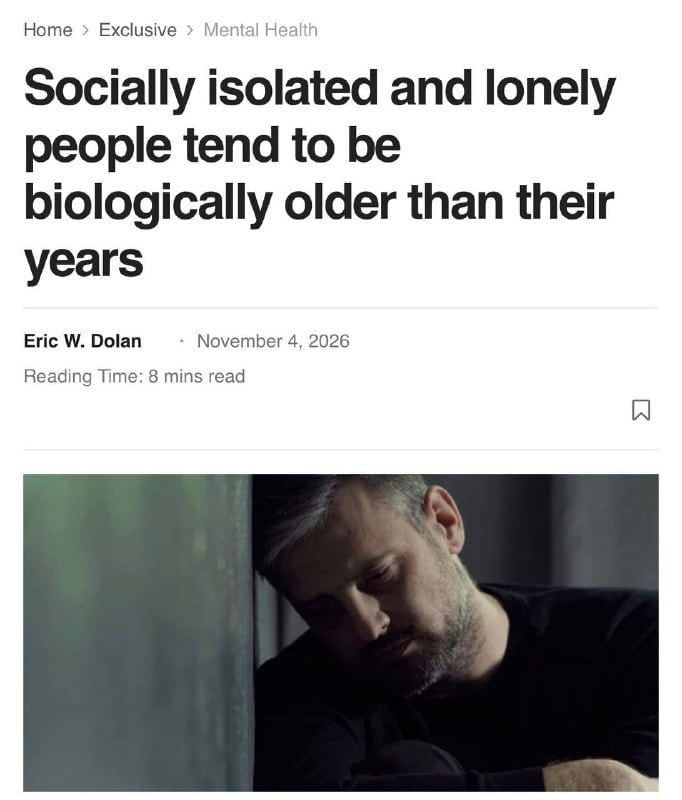
People suffering from social isolation and loneliness have a biological age that significantly exceeds their chronological age. This claim is confirmed by a large-scale study published in the journal Health Psychology, which covered over 300,000 residents of the United Kingdom. The greatest gap between the actual state of the body and the age on the passport was observed in those who combined both conditions simultaneously.
The difference between chronological and biological age
Two people born on the same day may age at different rates. Chronological age is simply the number of years since birth, while biological age reflects the physiological state of cells, tissues, and organ systems. When biological age is higher than chronological age, researchers call this "accelerated biological ageing." Such a state is a marker of increased risk of chronic diseases and early death.
Social isolation and loneliness are two different aspects of social alienation that affect physical health. Social isolation is objective in nature and is characterised by a lack of contact: living alone, infrequent meetings with relatives or friends (less than once a week), and lack of participation in community groups. Loneliness is subjective emotional suffering from a feeling of separation or the lack of a close person with whom to share experiences. This state can occur even when there are many people around.
Since these conditions do not always coincide, the authors note that simply increasing social contacts may not fully neutralise the health risks associated with loneliness, and vice versa. It is believed that both types of alienation burden the body through chronic psychological stress, deterioration of healthy lifestyle habits, and disruption of the immune system. For example, a large longitudinal study based on the same UK Biobank cohort found a link between loneliness and social isolation and elevated levels of specific inflammatory and immune proteins in the blood, which in turn correlated with higher rates of heart disease, stroke, diabetes, and mortality over a 14-year observation period.
Methodology and study participants
The co-first author of the study is Rui Mao, a resident, assistant researcher, and postdoctoral fellow in the Department of Dermatology at Xiangya Hospital of Central South University. The corresponding author is Xin Meng, a resident and assistant researcher in the Department of Dermatology at the First Affiliated Hospital of Southern Medical University and Xiangya Hospital of Central South University. Together with colleagues from other Chinese medical institutions, they investigated how social isolation and loneliness, separately and jointly, affect accelerated biological ageing, whether genetic predisposition to ageing modifies this link, and whether accelerated biological age helps explain the association between social alienation and mortality.
«Наше дослідження зосереджене на старінні та факторах, що формують здоров'я протягом усього життя, — розповіли Mao та Meng виданню PsyPost. — Соціальна ізоляція та самотність пов'язані з гіршим здоров'ям, але їхній зв'язок із біологічним старінням, особливо коли вони виникають одночасно, залишається менш зрозумілим. Ми хотіли з'ясувати, чи пов'язані менша кількість соціальних зв'язків та відчуття самотності з більш старим біологічним профілем» ("Our study focuses on ageing and the factors that shape health throughout life," Mao and Meng told PsyPost. "Social isolation and loneliness are associated with poorer health, but their link to biological ageing, especially when they occur simultaneously, remains less understood. We wanted to determine whether fewer social connections and feelings of loneliness are associated with an older biological profile").
Researchers analysed data from 309,746 adult participants in the UK Biobank, a large national health database in the United Kingdom. The average age of participants at the start of the study was approximately 56 years, and 54% of them were women. Participants were recruited between 2006 and 2010, and observation of health status and survival continued until July 2023. The median observation period was 14.4 years. The study was a secondary analysis of existing cohort data, and prior registration was not reported.
Assessment of social conditions and biological age
During the initial assessment, participants completed questionnaires regarding social habits and feelings. Social isolation was assessed on a scale from 0 to 3: one point for living alone, one point for visiting friends or family less than once a week, and one point for lack of participation in weekly group activities (sports clubs, religious groups, social clubs, adult education courses). At the baseline, 40% of participants had a moderate level of isolation (1 point), and 14% had a high level (2 or 3 points). Loneliness was assessed on a scale from 0 to 2: one point for frequently feeling lonely and one point for having almost no close person to share with. 4% of participants received the maximum score of 2 and were classified as lonely.
To measure biological age, scientists used the clinical PhenoAge formula, which estimates physiological age based on routine blood biomarkers, including markers of inflammation and organ function. Accelerated biological age was calculated as the difference between the participant's PhenoAge and the expected value for their actual age. A polygenic risk score was also calculated for each participant, which summarises the hereditary predisposition to accelerated biological ageing based on DNA variations.
Results: impact on age and mortality risk
In statistical models that controlled for age, sex, race, income, education, area deprivation, body mass index, smoking, alcohol consumption, physical activity, grip strength, diet, sleep patterns, sun exposure, and personal history of diabetes, cardiovascular diseases, hypertension, stroke, and cancer, both types of alienation were associated with older biological age. Each one-point increase in the social isolation scale corresponded to a 0.17-year increase in accelerated biological age, and each one-point increase in the loneliness scale corresponded to a 0.15-year increase.
Compared with the least isolated participants, those belonging to the most isolated group demonstrated accelerated biological age by 0.33 years, which is approximately four months. Participants classified as lonely had accelerated biological age by 0.24 years, or about three months, compared with those who were not lonely.
«Це незначні середні відмінності в показнику старіння, а не оцінки втрачених місяців життя чи прогнози для окремої людини, — пояснили дослідники. — Їхня потенційна цінність полягає в тому, що вони можуть розкривати про соціальні умови та здоров'я в масштабах великої популяції» ("These are small mean differences in an ageing metric, not estimates of lost months of life or predictions for an individual," the researchers explained. "Their potential value lies in the fact that they may reveal information about social conditions and health at a large population scale").
The authors note that their fully adjusted estimates likely underestimate the overall association, as some factors they controlled for (e.g., smoking, sleep, chronic diseases) may themselves be pathways linking social alienation to ageing. If only demographic and socioeconomic factors were considered, the most isolated group was biologically older by approximately seven months, and the lonely group by nine and a half months.
When analysing individual questionnaire items in the fully adjusted model, it was found that living alone was associated with accelerated biological age by 0.27 years, lack of a person to confide in by 0.22 years, lack of participation in weekly social activities by 0.17 years, frequently feeling lonely by 0.14 years, and infrequent visits from friends or family by 0.09 years. When researchers considered social isolation and loneliness together, they found an additive pattern: people who were simultaneously highly isolated and lonely had the greatest accelerated biological age.
«Одне з відкриттів, яке виділялося, — це зв'язок між обмеженою емоційною підтримкою та прискоренням біологічного віку, — зазначили Mao та Meng. — Відсутність людини, з якою можна поділитися, показала зв'язок, принаймні порівняний за величиною з відчуттям самотності. Це підкреслює важливість звертання уваги не лише на кількість соціальних контактів, а й на наявність стосунків, в яких людина відчуває підтримку» ("One of the findings that stood out was the link between limited emotional support and accelerated biological age," Mao and Meng noted. "The absence of a person to share with showed a link at least comparable in magnitude to the feeling of loneliness. This highlights the importance of paying attention not only to the number of social contacts but also to the presence of relationships in which a person feels supported").
Genetic factor and causal links
After integrating genetic data, researchers did not find a statistically significant interaction between genetic risk and social alienation, meaning that isolation and loneliness did not multiply the effect of genes associated with ageing. However, genetic and social risks accumulated on top of each other. Compared with people with low genetic risk and minimal isolation or loneliness, participants with high genetic risk of accelerated biological age and high social isolation were biologically older by approximately 1.7 years, and those with high genetic risk and loneliness by about 1.85 years. For comparison, isolation and loneliness separately are associated with a gap of about four and three months.
Subgroup analysis also showed that the link between loneliness and accelerated biological age was stronger among men, people under 60 years old, those with lower income, people who had never smoked, and those with unhealthy sleep habits. The link between social isolation and accelerated biological age did not have significant differences by sex, body mass index, or sun exposure.
To avoid the assumption that poor health forces people to withdraw from society rather than the other way around, researchers conducted a two-sample Mendelian randomisation analysis. This method uses genetic variants associated with behavioural traits to test directional links with health outcomes. Since these genetic variants are fixed at conception, they are not influenced by later health problems, reducing the likelihood that poor health is the cause of the association. In this analysis, genetic predisposition to loneliness was positively associated with accelerated biological age, while genetic tendencies towards regular gym or sports club attendance and participation in a religious group were associated with lower levels of accelerated biological age. Genetic predisposition to visiting a pub or social club had no statistically significant link with accelerated biological age.
Finally, the team analysed death records over the 14.4-year observation period. Each one-point increase in the social isolation score was associated with a 13.9% increase in the risk of death from any cause, and each one-point increase in the loneliness score was associated with an 8.9% increase in the risk of death from any cause. Both traits were also associated with higher mortality rates specifically from coronary artery disease and cancer.
An exploratory mediation analysis investigated whether accelerated biological age lies on the pathway between social alienation and mortality. According to the model assumptions, only approximately 5.2% of the link between isolation and death and 7.2% of the link between loneliness and death were statistically attributed to accelerated biological age.
Limitations and perspectives
These results are consistent with a study by the Mayo Clinic, which assessed biological age using artificial intelligence that reads heart electrocardiograms rather than blood tests, and which also linked social isolation to accelerated biological ageing and increased mortality risk. They also align with a study of older Chinese adults, which linked poorer psychological well-being, including loneliness and unhappiness, to older biological age, although in that study loneliness was measured as part of a broader well-being scale.
The authors suggest that different types of group activities may affect biological ageing through different channels. They assume that sports clubs and gyms may help because they involve regular physical exercise, while participation in religious events is associated with lower rates of depression and better self-rated health. Since genetic risk and social alienation acted independently rather than interacting, researchers also note that reducing loneliness and isolation may benefit people at all levels of inherited genetic risk.
«Наші результати свідчать про те, що соціальні зв'язки заслуговують на увагу, коли ми розглядаємо здорове старіння, — сказали дослідники. — Наявність людей навколо та відчуття емоційного зв'язку — це різні досвіди, тому можливості для соціальних контактів та доступ до значущої підтримки заслуговують на розгляд. Ці результати дають привід серйозно ставитися до соціального благополуччя, хоча вони не доводять, що збільшення соціальних контактів оберне процес старіння» ("Our results suggest that social connections deserve attention when we consider healthy ageing," the researchers said. "Having people around and feeling an emotional connection are different experiences, so opportunities for social contact and access to meaningful support deserve consideration. These results provide a reason to take social well-being seriously, although they do not prove that increasing social contacts will reverse the ageing process").
As with any study, certain caveats should be considered when interpreting these results. Even with over a decade of mortality observation, reverse causation cannot be ruled out, as people experiencing worse physical decline may become less capable of socialising or more prone to feeling lonely.
«Головне застереження полягає в тому, що наші результати не слід інтерпретувати як доказ того, що самотність безпосередньо спричиняє старіння, або що вступ до соціальної групи зробить когось біологічно молодшим, — сказали Mao та Meng виданню PsyPost. — Біологічний вік оцінювався в один момент часу, тому ми не могли відстежувати, як змінювалися траєкторії старіння індивідів зі зміною їхніх соціальних обставин. Наші генетичні аналізи наділили доповнюючі докази, але вони також залежать від припущень і не можуть замінити інтервенційні випробування» ("The main caveat is that our results should not be interpreted as evidence that loneliness directly causes ageing, or that joining a social group will make someone biologically younger," Mao and Meng told PsyPost. "Biological age was assessed at a single point in time, so we could not track how individual ageing trajectories changed with changes in their social circumstances. Our genetic analyses provided complementary evidence, but they also rely on assumptions and cannot replace interventional trials").
Genetic instrument analyses have several specific limitations. Genetic summary data for the full social isolation scale were unavailable, so Mendelian randomisation could only test individual habits, such as gym or religious service attendance, rather than overall isolation. Furthermore, genetic variants associated with habits such as gym attendance may affect biological ageing through other biological pathways rather than through social participation itself, genetic proxies do not perfectly reflect actual survey responses, and the estimate linking genetic predisposition to loneliness with biological ageing had a wide confidence interval.
Finally, the questionnaires used in the UK Biobank relied on only a few short items to capture loneliness and isolation and did not account for marital status in the index. The participant pool was also predominantly of European descent and from the United Kingdom, meaning that the results may not automatically generalise to other cultural environments where family structures and community norms differ.
Since the team studies ageing from a dermatology perspective, their interests extend to how ageing manifests in tissues such as skin. «Наша ширша мета — ідентифікувати потенційно модифіковані фактори, пов'язані з біологічним старінням, та зрозуміти їхню значущість для здоров'я, включаючи здоров'я шкіри, — пояснили дослідники. — Важливим наступним кроком було б дослідити, чи супроводжуються зміни соціальних зв'язків змінами біологічного старіння, використовуючи повторні вимірювання та більш різноманітні популяції. Зрештою, потрібні інтервенційні дослідження, щоб перевірити, чи може зменшення самотності або покращення соціальної підтримки дати вимірювані біологічні переваги» ("Our broader goal is to identify potentially modifiable factors associated with biological ageing and understand their significance for health, including skin health," the researchers explained. "An important next step would be to investigate whether changes in social connections are accompanied by changes in biological ageing, using repeated measurements and more diverse populations. Ultimately, interventional studies are needed to test whether reducing loneliness or improving social support can yield measurable biological benefits").
«Ми сподіваємось, що це дослідження заохотить до більш співчутливого розуміння самотності та соціальної ізоляції, — додали Mao та Meng. — Соціальні обставини формуються здоров'ям, мобільністю, обов'язками з догляду та доступом до громадських ресурсів, тому наслідки виходять за межі індивідуальних виборів. Наші результати підтримують подальше дослідження соціальних зв'язків як частини ширших умов, що сприяють здоровому старінню» ("We hope that this study will encourage a more compassionate understanding of loneliness and social isolation," Mao and Meng added. "Social circumstances are shaped by health, mobility, caregiving responsibilities, and access to community resources, so the consequences go beyond individual choices. Our results support further research into social connections as part of the broader conditions that promote healthy ageing").
The study "Social Isolation, Loneliness, and Biological Aging Acceleration" was authored by Rui Mao, Jiao Yuan, Tongtong Zhang, Fan Wang, Yun Zhong, Haonan Yuan, Fan Yang, and Xin Meng.








Comments
No comments yet. Be the first!