An analyst operating under the pseudonym LibertyLynx has published a detailed report claiming that SpaceX, owned by Elon Musk, was involved in the interception of the American radar satellite ICEYE-X36 by a Russian military satellite. According to him, SpaceX deliberately blocked the satellite's operation while simultaneously restricting the functionality of the Starlink network during a massive missile attack on Ukraine.
Timeline of events, 13–15 October
In his post, the analyst outlines a sequence of actions which, in his opinion, indicate coordination between SpaceX and Russian military forces:
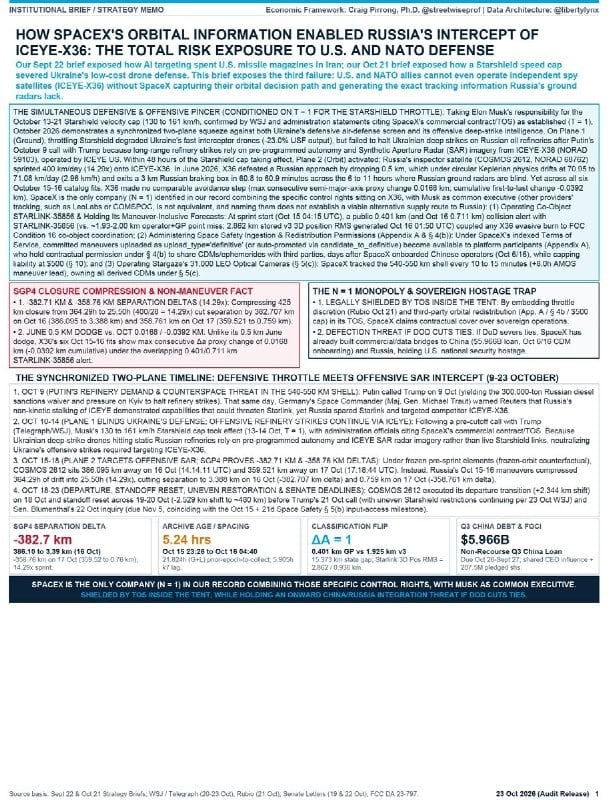
13–14 October: SpaceX restricted Starshield/Starlink operations during a Russian attack involving 39 missiles, resulting in a 23% reduction in the interception of Ukrainian drones and leaving US personnel in Kyiv without communication. Forty-eight hours later (15 October), SpaceX blocked the US-licensed radar satellite ICEYE-X36, owned by the NRO, Space Force, and NATO, in orbit so that the Russian satellite "COSMOS-2612" could intercept it (probability 99.89%–99.98%).
Our model shows that the interception of the US/NATO ICEYE X-36 satellite by Russia (which occurred simultaneously with the reduction in Starlink network power) would have been impossible and, almost certainly, would not even have been attempted without SpaceX resources. Suffering significant opportunity costs, Russia urgently launched its "COSMOS" satellite to intercept ICEYE X-36. Given the previous attempt in June, during which X-36 performed a manoeuvre to avoid a collision with "COSMOS", Russia knew this would only succeed if X-36 was unable to manoeuvre. On 15 October, SpaceX pinned X-36 in place by issuing a collision warning due to an approach to less than one kilometre from its satellite "Starlink 35856", although SpaceX's own data showed the actual distance was 4.8–5.0 times greater. SpaceX did not issue any warning for COSMOS, despite its rapid movement posing a far greater threat than the stable orbit of X36. SpaceX did not manoeuvre its satellite Starlink 35856 to eliminate the predicted collision risk. How, in the absence of coordination with SpaceX, could Russia have known that SpaceX would take measures that (a) distorted the danger posed by X36, and (b) resulted in X36 being pinned, thereby enabling a successful interception by COSMOS? Thus, SpaceX was directly involved in the simultaneous undermining of Ukraine's defensive and offensive capabilities. The combination of these two events makes innocent explanations unlikely.
SpaceX was the only organisation that simultaneously had continuous orbital tracking ("Stargaze") and manoeuvre control ("Space Safety") to coordinate the interception; all alternative tracking systems, including—most importantly—Russia's own ground network, lost contact with the object during multi-hour "blind" intervals for most of the acceleration and interception phase. USSF/NRO/NATO were undoubtedly concerned, as they had to sit in their control rooms and watch COSMOS 2612 approach their contracted radar assets, while SpaceX's ground channel at a speed of 101–161 km/h jammed Starshield, and SpaceX's 540–550 km orbital shell and FCC Condition 16 portal blocked ICEYE-X36, forcing it to freeze in a manoeuvre at a distance of 16.815 m (-96.64%)!
They had been monitoring the approach of the Russian satellite (COSMOS 2612) for five months, but what NRO, USSF, and NATO did not foresee was that their own domestic defence contractor (SpaceX) had quietly created an integrated architecture combining regulatory frameworks, software, and an orbital shell that allowed a single supplier (N = 1) to simultaneously act as a bottleneck at both ends of the kill chain.
The expert emphasises that without SpaceX's involvement, the interception would have been impossible, as Russian ground infrastructure lacked the necessary coverage for prolonged target tracking. According to his calculations, SpaceX was the only entity with access to continuous monitoring and manoeuvre control systems, which allowed it to create the conditions for the successful action of the COSMOS-2612 satellite.




Comments
No comments yet. Be the first!