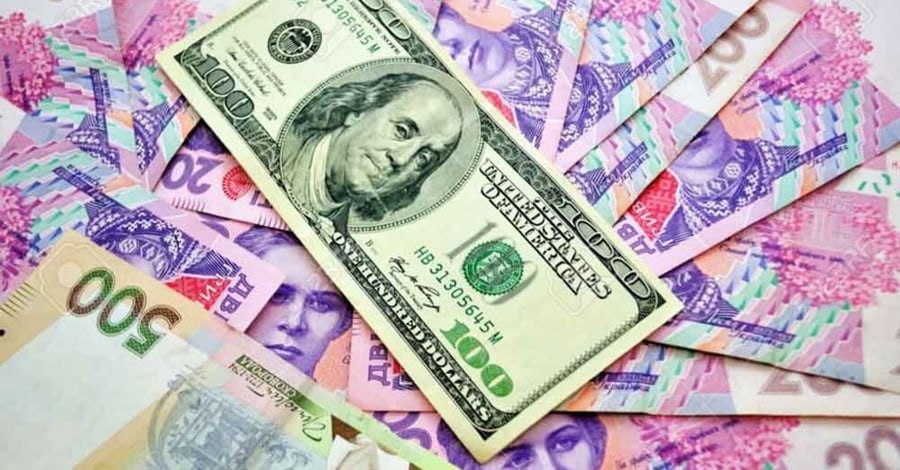
Currency rates on 21 November: dollar up to 45.75 UAH, euro exceeds 50 UAH
The cash currency market will operate with a high spread on Saturday. Experts explain why prices differ at exchange offices and how to choose a favourable offer.
The cash currency market will operate with a high spread on Saturday. Experts explain why prices differ at exchange offices and how to choose a favourable offer.

A ballistic missile that failed to detonate has been found in the courtyard of a residential building in the capital's Podil district.

Banking secrecy protects transfer data, but financial monitoring can flag unusual activity. Only business income or gifts from non-relatives are taxable.

Stablecoin supply has shrunk by $16bn over the past 30 days, marking the fastest outflow of funds since 2022. Experts discuss the causes of this phenomenon and its potential implications for the crypto market.

The TV presenter shared an archival photo with her grandmother and told about a strange coincidence that linked her childhood to her first major career trip.

Nikolov from the Centre for Countering Corruption commented on Kravchenko's investigation, claiming that such reports gradually undermine public trust rather than evidence specific offences.

Expert Serhiy Kuyun forecasts further cheapening of fuel at gas stations over the coming weeks. The main factor is the sharp drop in global oil prices and market normalisation.

According to Russian media, two drones attacked a sea vessel in the neutral waters of the Gulf of Finland during its voyage to Kaliningrad.
According to data from analytics platforms DefiLlama and Nansen, the total supply of stablecoins decreased by approximately $16bn over the last month. The market fell to a level of $283–286bn. Specifically, USDT lost around $8bn, while USDC dropped by approximately $3.5bn. The service Glassnode recorded a reduction of $14.2bn over the 30 days leading up to 9 November, describing it as the fastest outflow of funds since June 2022.
This dynamic resembles the events of June 2022, when the market witnessed the collapse of Terra and Luna, and the bankruptcies of Celsius and FTX. At that time, mass panic and a significant outflow of investments from crypto assets were observed.
On 19 November, the publication CoinDesk published the results of an investigation by Inca Digital. It emerged that $518mn had passed through the stability module of the USDS stablecoin from Sky over several years from 422 wallets linked to hackers and sanctioned entities. According to Inca, approximately $91.5mn of this sum originated from the hack of the Bybit exchange, which is attributed to North Korea.
The primary risk is cited as structural vulnerability: the entire USDC reserve is held on a single address. This means that a court order could freeze not only the suspicious portion but the entire reserve. On that same day, more than $1.5bn in USDC was withdrawn from this reserve. Blockchain data indicates that the majority of the funds were withdrawn by one large wallet, which analysts link to the Poloniex exchange, although the exchange's direct involvement has not yet been proven. Within a day, the USDS supply fell by more than a third, to $3.2bn, although the token maintained its peg to the dollar.
Nansen analyst Nikolai Sondergaard explains that funds disappearing from stablecoins are primarily returning to fiat dollars rather than moving into other tokens. This is linked to falling crypto prices and high benchmark rates, which makes holding dollars on the blockchain less profitable. For instance, on 15 November, the price of bitcoin dropped to $62,000, a minimum since July.
There is also another theory, discussed in the crypto community since 2018–2019. The scenario posits that after a period of growth and mass adoption of crypto, crises, hacker attacks, and problems with stablecoins follow. This leads to a loss of trust and a market decline, after which states offer their own digital currencies (CBDCs), guaranteed by the government. For example, in Russia, the digital ruble was launched on a mass scale on 1 September. The US, however, is choosing a different path: it has banned CBDCs and is betting on regulated private stablecoins.
Although these events do not prove that anyone knew in advance about a future collapse of USDT or USDC, the simultaneous market contraction and the withdrawal of billions by large addresses indicate that major players are likely hedging their risks in advance.
As Changpeng Zhao once noted, "one bitcoin equals one bitcoin". Attention should now be paid not so much to the price of bitcoin, but to the situation with dollars within the crypto ecosystem. Stablecoins serve as "fuel" for the market: investors buy USDT or USDC with dollars, then use them to purchase bitcoins, ethers, altcoins, and participate in DeFi protocols. If the market falls and the "fuel" is exhausted, it becomes impossible to buy assets.
Against the backdrop of increased state regulation of the crypto industry, the process of capital outflow has already begun. As observers note, when fuel is leaking from the tank, it is already too late to watch the speedometer.
Comments
No comments yet. Be the first!