Italian brand's court victory in Ukraine
On 26 July 2012, Anton Shukhin, owner of the Domino chain, filed an application to register the JACOB COHEN mark. It was only in 2015 that he received certificate No. 199402, which granted the right to use the mark for clothing, footwear, and retail trade. However, by that time, the Italian side had already held valid international registrations (from 2004 and 2007) for eight years. In October 2025, the Pecherskyy District Court of Kyiv ruled that the Ukrainian certificate is invalid, as the Italian marks have priority and their similarity is capable of misleading consumers. The Lithuanian company UAB Domino Grupe is listed among the defendants in this case.
Dispute over Stefano Ricci representation
The situation with the Stefano Ricci brand is of a different nature. The Domino chain positions itself as the official representative of the Florentine house in Ukraine. Meanwhile, court proceedings have been ongoing regarding the Ukrainian registration of STEFANO RICCI, in which Shukhin was involved. The Paris Convention described the situation where a representative registers their principal's name in their own name more than half a century ago. In such a case, the true owner of the mark has the legal right to demand the cancellation of such a registration.
Mechanism of using others' rights
A certificate issued in another person's name functions as a control tool. It allows the mark to be entered into the customs register, enabling the seizure of third-party goods shipments at the border. This makes it possible to block competitors importing the same brand, or the certificate holder may approach the true rights holder to negotiate the price for returning the "key". Documents to be disclosed later will show which specific scenario was used in this case.
Rights holder's reaction and international cooperation
The company Absolution has already established contact with lawyers from Jacob Cohen Company S.p.A. The Italian side will soon provide materials regarding the history of registrations and the use of the mark. Further investigation will be conducted jointly with the rights holder's lawyers, taking into account all legal consequences in Ukraine and the European Union. Each document from Italy will be verified as evidence for both jurisdictions.
Legal consequences in the EU
If the use of the marks on the territory of the European Union is confirmed, the Italian rights holder will be able to sue Shukhin in their own country. Under the EU Trademark Regulation, if the defendant does not reside or have an establishment in the EU, the claim is filed in the court of the plaintiff's country. The decision of such a court is binding throughout the Union's territory. The Lithuanian UAB Domino Grupe is being tried in Lithuania, and the decision will have force throughout the EU.
An Italian court, guided by the Industrial Property Code, can prohibit the use of the mark, withdraw goods from circulation, impose a fine for each day of non-compliance with the decision, recover damages along with profits obtained from the use of another's name, and oblige the infringer to publish the decision at their own expense. A registration in the EU filed in bad faith is annulled. The owner can also demand the transfer of the mark that the agent registered without consent.
Criminal liability in Italy
Article 473 of the Italian Criminal Code provides for punishment for counterfeiting or using another's mark, ranging from six months to three years of imprisonment and a fine of up to 25,000 euros. Article 474 punishes the import of goods with a counterfeit mark (from one to four years) and its sale (up to two years). If the offence is committed systematically through an organised structure, the penalty increases to six years, and the fine to 50,000 euros. Goods are confiscated. Liability of legal entities is provided for by Law 231/2001. These articles apply if the goods or sales relate to the territory of Italy, which is currently being verified.
Customs control and consequences in Ukraine
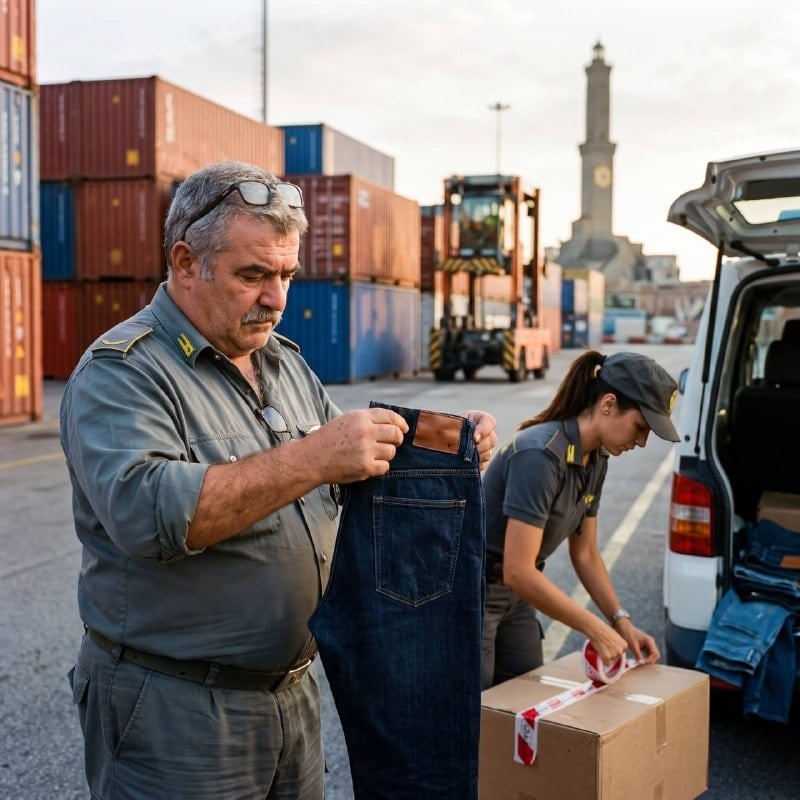
In accordance with EU Regulation 608/2013, the customs authority of any Union country (including Lithuania and Italy) is obliged to detain a shipment of goods upon the application of the rights holder.
In Ukraine, illegal use of a mark is punishable under Article 229 of the Criminal Code. For causing significant harm, a fine of 1,000 to 4,000 non-taxable minimums (from 17,000 to 68,000 hryvnia) is provided, and in serious cases, up to 170,000 hryvnia. Claims for compensation of damages are also possible. If goods of non-Italian origin were sold under the Italian name, this falls under other articles. This will be discussed in the next article.
We will send questions to Anton Shukhin, and his response will be published in full. The decision of the Pecherskyy Court may be appealed, and its status is currently being verified.
A certificate in another person's name is issued by a state authority, but the bill for it is paid by the rights holder.
To be continued. Next article: possible criminal-legal qualification in Ukraine.







Comments
No comments yet. Be the first!