
Russia passed Sijarto data on special operations against opposition in Hungary
Journalist Szabolcs Pany's book reveals how the Kremlin provided Fidesz with materials to discredit the Tisza party via diplomatic channels.
Journalist Szabolcs Pany's book reveals how the Kremlin provided Fidesz with materials to discredit the Tisza party via diplomatic channels.

Former Prime Minister Mykola Azarov claims that Ukrainian security agencies were involved in the car bombing of Serhiy Zavorotnyi in Moscow. He describes his former adviser as an opponent of the Maidan and the subsequent authorities.
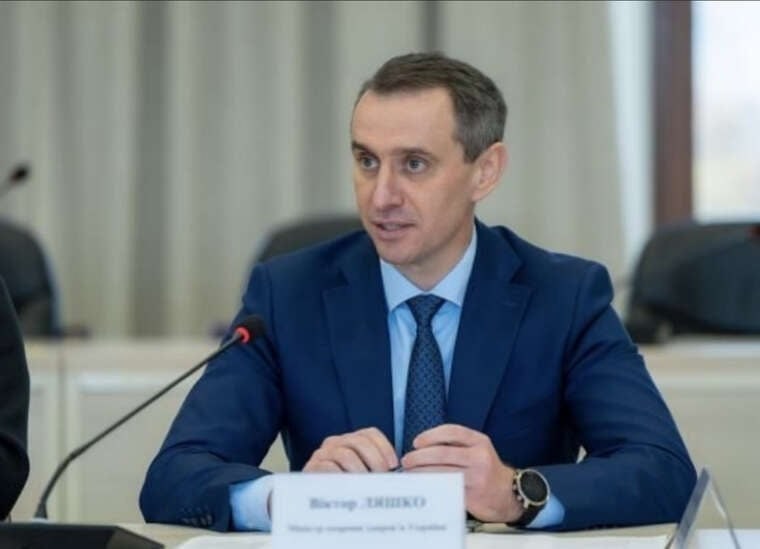
According to the Ministry of Health, 80.5% of experienced doctors use AI tools in their practice, despite the absence of current regulatory acts.

Due to the aftermath of Russian strikes on energy infrastructure, Ukrenergo announced planned power supply restrictions for industrial and household consumers on Saturday.
The security service confirmed a review of the actions of its staff featured in NABU materials and the dismissal of two officials. Details regarding access to cameras and General Duka remain unknown.

Brussels outlined the list of representatives responsible for contacts with Moscow. The group includes officials who previously participated in meetings in Abu Dhabi.

Retired Admiral Mark Montgomery stated that Ukraine has the potential to develop an affordable air defence system and become a leader in laser technologies.

Enterprises linked to former MP Denys Dzenzerskyi have accumulated significant debts to seven financial institutions. In 2026, Vesta Industrial was officially declared bankrupt.
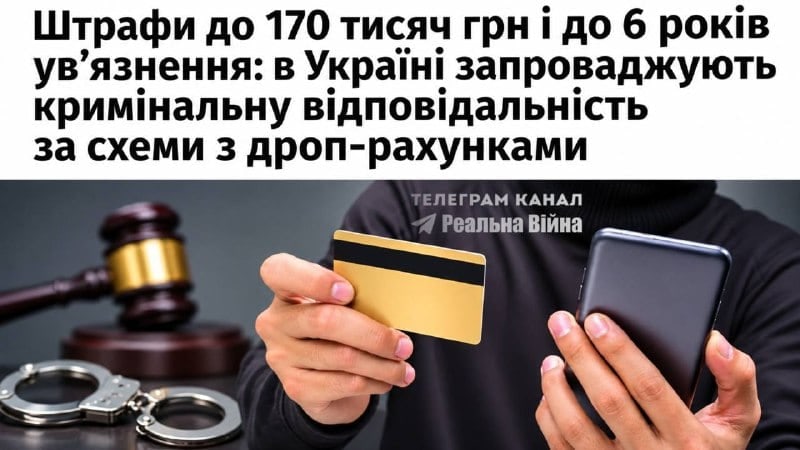
Volodymyr Zelensky has officially signed a law introducing criminal penalties for participation in schemes involving the use of others' or one's own bank accounts to commit crimes. The document provides for up to six years of imprisonment in the most serious cases.
This concerns the adoption of amendments to the Criminal Code and the Criminal Procedure Code of Ukraine (Law No. 5038-IX, draft 16013). The main objective of the regulatory act is to protect citizens and their financial resources from illegal actions involving payment instruments.
The key novelty of the law is the addition of Article 200-1 to the Criminal Code. It penalises the transfer of payment instruments, individual accounting information, or the provision of access to a bank account or electronic wallet with the aim of enabling other persons to commit fraud or another criminal offence.
Sanctions depend on the nature of the actions:
Thus, the maximum penalty under this article is six years of imprisonment.
The law is primarily aimed at organisers of "drop-account" networks and intermediaries who buy bank cards. However, ordinary citizens who deliberately provide access to their accounts to third parties for a reward may also fall under the scope of the norm.
Students, unemployed individuals, and other categories of the population to whom "easy earnings" are offered for transferring bank details are at particular risk. If it is proven that a person acted with the intent to have the account used for fraud, they bear criminal liability.
It is worth noting that the transfer of a card to another person in itself is not yet a crime. For prosecution, the investigation must establish the corresponding criminal intent, which will become a key issue in future judicial practice.
The law provides a mechanism that allows avoiding punishment. Persons who have committed an offence for the first time, as provided for in Part 1 of Article 200-1, and voluntarily reported it under the conditions established by the law, may be exempted from criminal liability.
This norm aims not only to punish but also to encourage participants in schemes to disclose the illegal circulation of payment instruments. However, this is not a general amnesty, as the exemption is limited to a specific composition of the offence.
In addition to the new article, the law updates the existing Article 200 of the Criminal Code. It now covers the forgery of payment instructions, messages, orders, payment instruments, means of access to accounts, electronic wallets, and accounting information.
Such actions are punishable by fines of 51,000 to 119,000 UAH or restriction or deprivation of liberty for a term of two to four years.
Separate liability is established for the illegal appropriation of others' payment instruments and accounting information, as well as the illegal obtaining of access to a bank or payment account. Such violations carry a fine of 68,000 to 136,000 UAH or restriction or deprivation of liberty for a term of three to five years. In case of recidivism or actions by a group of persons, the sanction may reach six years of deprivation of liberty.
Experts note that the wording "another criminal offence" in Article 200-1 makes the norm very broad. The scope of the law is not limited to financial frauds only. Therefore, for law enforcement, it will be critically important not only to record the fact of transferring a card but also to unequivocally prove the specific purpose of such a transfer.
During the expert analysis of the bill, issues were also raised regarding the demarcation of new compositions of offences from the current norms of the Criminal Code and the determination of the jurisdiction of the relevant proceedings.
Comments
No comments yet. Be the first!