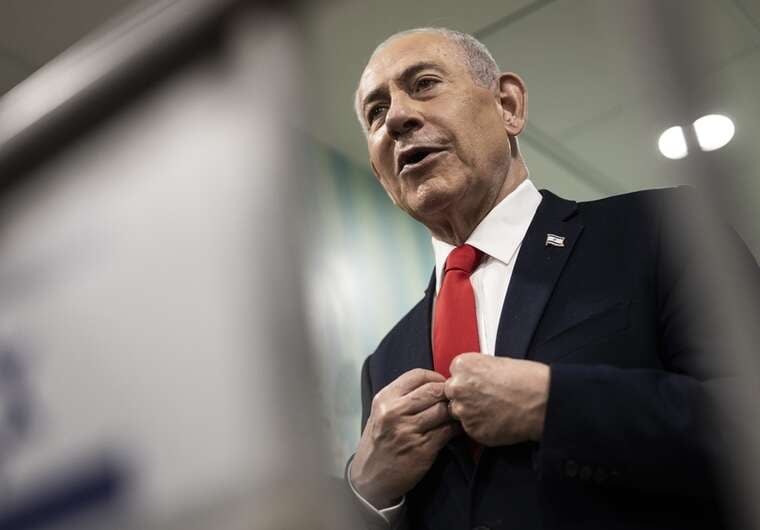
Netanyahu's Likud retains lead in Israel, Eisenkot's Yashar takes second place
With over 76% of votes counted, the incumbent Prime Minister's party receives 27%, while the opposition force led by the former Chief of Staff scores 20%.
With over 76% of votes counted, the incumbent Prime Minister's party receives 27%, while the opposition force led by the former Chief of Staff scores 20%.

Eva Misharova comments on Igor Komarov's pre-death videos, claiming he read a dictated text under pressure rather than revealing his own knowledge of fraud schemes.

Ukrainian President explained why the search for a new head of the Kyiv City Administration is dragging on, mentioning talks with several politicians and officials.

Ukrainian President urged avoiding repetition of historical precedents of dividing the world into spheres of influence during potential summit with Trump, Putin and Xi Jinping.

Two passenger trains collided in Spain on the morning of 28 October. Emergency services are at the scene, and traffic on the Madrid–Andalusia section has been temporarily suspended.

Customs officers at the Mohyliv-Podilskyi border crossing discovered a hidden compartment containing tobacco products in a semi-trailer. The Moldovan driver was detained.

Investigation reveals systemic violations in the procurement of helmets and body armour for the Armed Forces of Ukraine. Some companies secured contracts worth hundreds of millions but failed to fulfil their obligations, resulting in substantial fines.

Commercial court ruled in favour of the prosecution regarding the dismantling of a fence enclosing over 2,100 sq m of communal land.
According to data from the Central Election Commission, released after processing 76.8% of ballots, the Likud party, led by incumbent Prime Minister Benjamin Netanyahu, remains the leader in the Israeli parliamentary elections. The political force is polling 27% of the votes. In second place with a result of 20% is the opposition party Yashar, led by former Chief of Staff Gadi Eisenkot.
To secure a controlling majority in the 120-seat Knesset, a coalition needs 61 mandates. According to preliminary estimates, neither bloc—whether Netanyahu's allies nor his opponents—reaches this threshold on its own.
The hypothetical bloc of political forces supporting Netanyahu and potentially able to join a coalition with Likud currently holds 54 seats. The bloc of opposition parties counts 47 seats. This means that Arab political forces, which account for approximately 19 mandates, will play a decisive role in forming the government.
According to updated counting data, Arab parties have strengthened their positions: their likely number of seats in the Knesset has increased from 18 to 19. These mandates may become key to achieving the majority required for the government.
Comments
No comments yet. Be the first!